
Best Boutique Clothing Online: A 2026 Guide
Table of Contents
- What Makes Boutique Clothing Different From Chain Stores
- How to Style Boutique Clothing for Work and Weekends
- Why Independent Fashion Labels Australia Shoppers Trust Are Worth the Search
- How to Judge Quality and Fit Before You Buy Online
- Price, Sustainability and Returns: What to Check First
- Building a Wardrobe That Works for Real Life
- Conclusion: Finding Your Best Boutique Clothing Match
- Frequently Asked Questions
Last Updated: September 16, 2026
What Makes Boutique Clothing Different From Chain Stores
Boutique clothing is a curated, small-scale retail approach where a buyer handpicks a limited run of garments from independent and niche labels, rather than stocking hundreds of identical pieces. The result is a wardrobe that feels personal instead of mass-produced.
A chain store buys in bulk to hit a price point. A boutique buys in small quantities and drops a style when it sells out. You are less likely to see your dress on three other people at the same event, and more likely to find a cut a mass retailer would consider too risky to produce.
The trade-off: small runs mean limited sizes and limited restocks.
How to Style Boutique Clothing for Work and Weekends
The trick to styling boutique clothing is to treat each piece as part of a small, flexible set rather than a one-off statement. Start with neutral bases, then let the distinctive piece do the talking. A boutique wardrobe earns its keep when the cut suits your shape and the piece crosses from desk to dinner without a full change.
Here is a simple three-piece rule that works for most wardrobes:
- One anchor piece. A structured blazer, a tailored midi dress or a well-cut jumpsuit.
- Two supporting basics. A plain knit, a crisp shirt or straight-leg trousers in a neutral tone.
- One accent. Jewellery, a scarf or a bag that carries the colour.
For the office, pair a formal dress with a knit cardigan and low heels. For the weekend, take the same dress and add sneakers and a crossbody bag. Same garment, two registers.
Styling by Body Type, Not by Trend
Most boutique styling advice stops at "know your shape" without explaining what that means. A more useful approach is to match the garment's construction to your proportions, because boutique labels cut for a specific fit model, rarely you.
- Pear (narrower shoulder, fuller hip). Look for A-line skirts, fit-and-flare dresses and structured shoulders. Avoid clingy bias-cut slips unless the fabric has weight, as lightweight bias satin tends to highlight the hip rather than skim it.
- Apple (fuller midsection, slimmer legs). Empire lines, wrap dresses and open-front longline cardigans work well. A defined waist seam placed too high or too low will pull; look for a seam that sits at your natural waist, not the model's.
- Hourglass (balanced bust and hip, defined waist). Wrap dresses, belted shirt dresses and high-waisted tailored trousers. Avoid boxy oversized knits that erase the waist entirely.
- Rectangle (bust, waist and hip close in measurement). Create curve with peplums, ruched side seams, belted waists and layered textures. A plain shift dress in a stiff fabric will read flat.
- Inverted triangle (broader shoulder, narrower hip). Wide-leg trousers, full or pleated skirts and V-necks. Skip shoulder pads and boat necks.
The practical test: measure your bust, waist and hip in centimetres, then compare the differences.
Building a Travel Wardrobe From Curated Basics
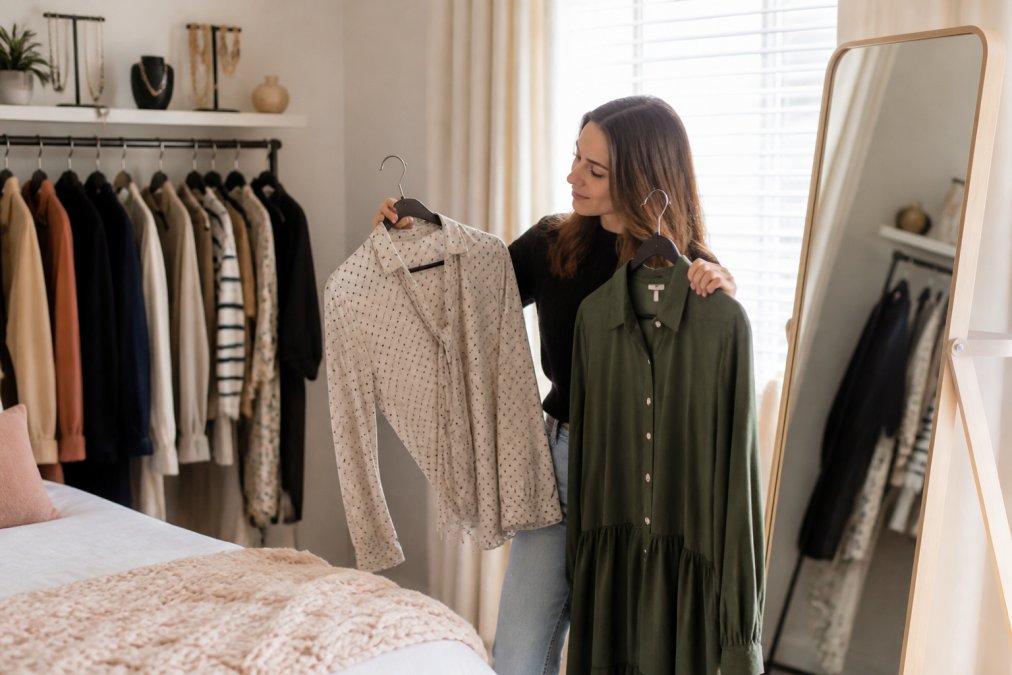
Why Independent Fashion Labels Australia Shoppers Trust Are Worth the Search
How to Judge Quality and Fit Before You Buy Online
Look for these signals:
- Fabric content listed by percentage, not just "soft blend"
- Specific measurements for bust, waist and hip in centimetres
- Photos on more than one body type where available
- A stated returns window you can actually use
Sizing Consistency Across European and Local Brands
| What to Check | Why It Matters | What Good Looks Like |
|---|---|---|
| Fabric composition | Predicts drape, warmth and wear | Percentages listed, not vague terms |
| Size chart | Prevents fit returns | Measurements in centimetres |
| Construction notes | Signals longevity | Named seams, lining, closures |
| Returns policy | Protects your money | Clear window and condition rules |
Price, Sustainability and Returns: What to Check First
Price, sustainability and returns should be checked before you fall for a piece, not after.
Price-to-Quality: The Cost-Per-Wear Test
- How many existing pieces will this match? If the answer is fewer than three, the realistic wear count drops sharply.
- What is the fabric weight and composition? A heavier cotton, wool or silk blend generally survives more washes than a thin synthetic. Check the percentage breakdown, not the marketing description.
- Does the construction support repeat wear? Look for named seams, lined bodices, reinforced buttonholes and quality closures. These are the details that decide whether a garment lasts two seasons or ten.
How to Read a Sustainability Claim
- Tier 1, Specific and verifiable. The label names its fabric mill, its manufacturer and the country of production, and states fibre content by percentage. Examples include labels that disclose a GOTS-certified organic cotton supply chain or a named family-run workshop.
- Tier 2, Directional but vague. The label says "ethically made" or "natural fibres" without naming who made the garment or where. This is a starting point, not proof.
- Tier 3, Slogans only. "Eco-friendly", "conscious" or "green" with no supporting detail. Treat this as marketing until the retailer answers a direct question.
Local Versus International Labels: What You Are Actually Choosing
Australian boutiques typically stock a mix of homegrown designers and international imports, which carry different trade-offs.
Returns: What Australian Consumer Law Guarantees
- Consumer guarantees apply automatically. Goods must be of acceptable quality, fit for the stated purpose, and match the description. These rights exist regardless of any store policy.
- Change-of-mind returns are not guaranteed by law. A retailer can choose whether to accept a return because you changed your mind, and can set its own window and conditions for that.
- Faulty goods are different. If a garment is faulty, significantly different from the description, or not fit for purpose, you are entitled to a remedy, a repair, replacement or refund, and the retailer cannot refuse by pointing to a change-of-mind policy.
- Return postage. For a change-of-mind return, the retailer may ask you to pay postage. For a faulty item, you should not be out of pocket for the return.
| What to Check | Why It Matters | What Good Looks Like |
|---|---|---|
| Fabric composition | Predicts drape, warmth and wear | Percentages listed, not vague terms |
| Size chart | Prevents fit returns | Measurements in centimetres |
| Construction notes | Signals longevity | Named seams, lining, closures |
| Sustainability claim | Tells you what you are supporting | Named maker, mill or certification |
| Returns policy | Protects your money | Clear window, condition rules, postage stated |
ACCC guide to consumer guarantees
Building a Wardrobe That Works for Real Life
Conclusion: Finding Your Best Boutique Clothing Match
Finding the best boutique clothing online australia has to offer comes down to fit, quality and trust, not just a pretty product photo.
Frequently Asked Questions
What defines a boutique clothing store compared to a major retailer?
A boutique clothing store carries a limited, handpicked selection rather than mass-produced stock. Buyers choose each piece, often from smaller local and European labels, so ranges change with the season and you are less likely to see the same dress on someone else. Major retailers buy in bulk to hit low price points, which usually means standardised sizing and faster turnover of cheaper fabrics. Boutiques trade volume for curation, so the trade-off is fewer options but more distinctive ones.
How can I check the quality of boutique clothing before buying online?
Ask for fabric composition and garment measurements rather than relying on a generic size label. Look for close-up photography showing stitching, lining and hardware, since these reveal construction quality faster than a styled shot. Check whether the boutique lists care instructions and fabric weight. If a site shows only model photos and no detail shots, email and ask. A boutique that stocks independent fashion labels will usually answer specific questions about where a piece was made and how it fits.
What should I look for in an online boutique's returns and shipping policy?
Check three things: the return window, who pays return postage, and whether refunds or credit notes are issued. Australian Consumer Law gives you a remedy if an item is faulty, significantly different from its description, or unfit for purpose, and no store policy can override that. Beyond your legal rights, a generous change-of-mind policy signals confidence in sizing. Also confirm dispatch timeframes and whether express shipping is available, especially if you need a piece for a specific date.
Are there sustainable fashion options among online boutiques?
Yes, and smaller boutiques are often better placed to offer them than large chains. Ask what a store does about dead stock, whether it names its makers, and how much of the range is produced in small batches. Local independent labels typically manufacture in shorter runs, which reduces unsold inventory. Be wary of vague claims like 'eco-friendly' with no detail. Specific information about fabric, origin and production volume tells you far more than a sustainability badge.